As with other stages of this boat building project, I quickly have fallen into a comfortable routine with the application of the topside varnish. After the coat on Sunday, the boat was allowed to dry for about 24 hours. Then last night I gave it a good sanding. This was my first attempt at wet sanding, using some 320-grit paper (made in Finland- not the horrible cheap stuff from India I have been using) and keeping a wet surface, I was really surprised how well things looked after the quick sanding session. Then this morning before work, I applied the third coat of Interlux Schooner varnish. A nice gloss is starting to develop, as well as a little depth in the varnish layer. Tomorrow evening, the cycle starts again for coat 4.
I also received my registration stickers from the Decal Zone. Very quick service, and the vinyl registration numbers look great. Total Hours 94.00.
The 2015 Everglades Challenge starts tomorrow, a 300 mile sprint down the West coast of Florida in all manner of small craft. Last year, Classic Moth champion Jeff Linton won the monohull division in his extensively modified Flying Scot.
This year we have a Classic Moth entered - well sort of. Joe Frohock picked up a Mistral Classic Moth that was languishing at the Gulfport Y.C. and made this tippy Moth into a trimaran - a Mothmaran. He unveiled the new Holland Tunnel over a year ago and in the interim he has already done a 100 miles jaunt in the contraption. Tomorrow will be the real deal.
Len Parker cant believe his eyes. The Mothmaran uses stock kit Chesapeake Light Craft amas. The fixed prodder flys a gennaker on a roller furler.
The familiar deep-Vee hull of the Mistral Classic Moth married to something different.
With everything unfurled there is plenty of sail for this 11-footer.
The crossbeams were stock lumber pieces screwed into the deck (the screws being replaced by through bolts when they started pulling out).
Joe Frohock, master cobbler together of disparate pieces into a very credible sailing machine.
The 2015 version, entered in the 300 mile Everglades Challenge. Additions are some fairings for the crossbeam attachments and a massive foredeck coaming to keep water out of the cockpit. The word from Earwigoagins reporter from Gulfport was once he loaded all the required Everglades gear he had water coming over the daggerboard trunk - time for a quick redesign! As with the sailing canoes entered there is no room for onboard sleeping! Good luck Joe!
Read George A.s blog post on the Mothmaran over here.
As mentioned in my post on the Lark Scow - The Laser of the 1900s, Thomas Day of The Rudder magazine encouraged the home-builders of the Lark to be inventive; there was no strong concept of one-design strictness at this genesis of small sailboat development. So builders strayed from the plans, building Larks with yachty looking counter sterns, with cuddy cabins, longer and shorter Larks and they gleefully sent reports of their modifications into The Rudder and Thomas Day published them.
In 1903, in The Netherlands, W. Beekhuis, owner of the boat building yard "Navis" te Loosdrecht, built a small Lark, only 3.6 meters long (11.8 feet). He built them from the time period 1903-1905 but it is unclear how many he actually produced.
The 1903 Beekhuis Mini-Lark
In 1919, A Van Gool, from the northern coastal district of Friesland, The Netherlands, built a Beekhuis type Lark with additional modifications. Having traveled to America and observed American sailboats, Van Gool borrowed the Star type keel and grafted it on the Beekhuis Lark scow hull. He made the hull longer, 4 meters (13.1 feet). He replaced the squat gaff rig with a taller gunter rig. This Larken Klasse would become very popular in Friesland and Twente during the 1920s and 1930s.
The Van Gool/Friesland Larken
In 1934, Romke Vries designed an even higher aspect, full battened gunter rig for the Larken Klasse. By the end of the 1930s the more modern O-Jolle singlehander centerboarder was cutting into the Larken Klasse numbers and, as the Finn dinghy and OK dinghy were introduced after World War II, the class continued to lose popularity. In 1965, the class made its last appearance at Sneekweek, seemingly destined to fade into obscurity.
That is until 2004 where a group of Larken Klasse enthusiasts banded together to start restoring the old Larkens and build new ones. In the short span of 11 years they have built the class up to where they are now getting a vibrant 20+ turnout at the major regattas. An amazing resurrection of a true classic!
The newer Larkens have adopted a more modern keel with a separate rudder. The lead ballast is 34 kg.
The present day Larken Klasse on a reach (Anyone know who the photographer is?)
A vintage photo of a happy Larken skipper.
At this years Sneekweek regatta, artist and small boat racing enthusiast, Jan Tekstra decided to jump into a different class each day and record his race on a GoPro. This is his Larken segment.
Acknowledgement: All of the history of the Larken Klasse was taken from this article by J.K Kuipers As I was tossing this post around my brain, the German Segel Reporter beat me to it by about two weeks and brought out Michael Kunsts post on the Larken Klasse.
Last years Archipelago Rally uncovered a historical gem with the entry of Yarrow Thornes Crosby Skimmer Moth. This year, another historical rarity made an appearance at the Archipelago Rally; Woody Underwoods International 12. (this is the American International 12, not to be confused with the lapstrake, George Cockshott 12 Dinghy, which is also sometime referred to as the International 12 and popular in Europe.) The International 12 was the first sailing dinghy to be built using hot molded veneers held under pressure in an autoclave, a building method that allowed mass production of a very strong, lightweight monocoque wood hull. It was a very revolutionary technology but also a temporary technology as fiberglass construction of boats came to the fore in the late 1950s, early 1960s. Thousands of wood boats were built post WWII using hot molded, autoclave construction. Most were small outboard runabouts but some are the familiar sailboats of today including the Fairey Marine and USOD International 14s, Thistles, Luder 16s, Fireflys, Jet 14s, and Jollyboat.
Woody Underwoods International 12 appears to be one of the first in the production run. Woody comments:
"My father bought this boat (# 31) in 1940, and it could be the first boat I ever sailed in. He was away in the service after that, and the boat was washed off its float in Padanaram in Hurricane Carol, ending up in the bushes 2 miles away. About 1960, we put in an Interclub mast, and I have sailed the boat on and off since then. Condition is good, albeit dried out.
Woody and Josie Whoolam sailing in the 2015 Archipelago Rally. Woody has retained the natural mahogany veneer look on the outside of the hull.
Photo from Rufus Van Gruissen
The International 12 was designed by International 14 designer, Harry Hall, who lived in New Rochelle, New York.
Photo from Woody Underwood
The first hot molded boats had very little internal structure - a feature designed to show off the strength of the new construction. The lack of ribs and stringers was a source of amazement to most.
Photo from Woody Underwood
The wood International 12 was also used by the U.S. Coast Guard Academy for their sail training and dinghy racing program.
Photo from Woody Underwood
Ernest Ratsey sailing the International 12 prototype in the summer of 1940.
The Rudder, October 1940
On a slightly different topic but still about the 2015 Archipelago Rally:
One cannot wrap up the 2015 Archipelago Rally without featuring the latest video report from the Tuthill Sisters. Last year, in the 2014 Rally, the younger sister had to become a human sidestay when the mast on their dinghy started falling over. This year the duo rolled out a Sailfish for the race, a choice that looked like a safe bet compared to their previous rickety dinghy and the slow - slow Snark, but the Sailfish has no cockpit and, sometime during the race the older sister ended up in the drink (she kept filming though).
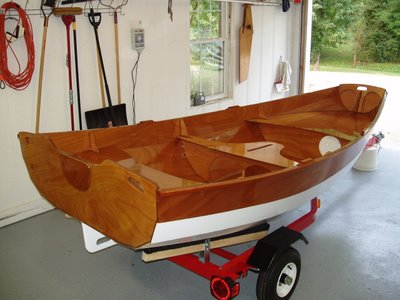 As with other stages of this boat building project, I quickly have fallen into a comfortable routine with the application of the topside varnish. After the coat on Sunday, the boat was allowed to dry for about 24 hours. Then last night I gave it a good sanding. This was my first attempt at wet sanding, using some 320-grit paper (made in Finland- not the horrible cheap stuff from India I have been using) and keeping a wet surface, I was really surprised how well things looked after the quick sanding session. Then this morning before work, I applied the third coat of Interlux Schooner varnish. A nice gloss is starting to develop, as well as a little depth in the varnish layer. Tomorrow evening, the cycle starts again for coat 4.


