Tampilkan postingan dengan label the. Tampilkan semua postingan

Jumat, 22 April 2016

Offsets for the French Fragniére Moth Classique

0

Plans de voiliers classiques Moth, Plans de dériveur classique Moth.


When I have some spare time I try to load a Classic Moth design onto the computer (usually with modifications, but hey, this is the beauty of the Classic Moth!). This time I have the offsets for the French Fragniére design, designed in the late 1950s and equivalent in design progression to the North American Mint or Cates design (which we classify as Generation 1). The Fragniére is a simple V-shape design with lots of rocker. The most unusual characteristic is the V-shaped transom bow which may not be at its best in open water but gives the design a distinctive look. This was a very popular design in France and should present the competent amateur with a straight-forward building project (except for the curved transom bow as shown in the plans - which would take some planning).

(To work with the PDF file, click the pop-out icon on the top right-hand corner to open the PDF file in another tab. From there you can print or download the file.)


Click here for the offsets of a three planker modified Fragniere Classic Moth design.

Read more

Kamis, 21 April 2016

Seen at the 2015 Annapolis Sailboat Show the Scamp Mini cruising Dinghy

0

I was frankly surprised to see this small dinghy cruiser at the Sailboat Show. This 12 (3.6 m) mini-dinghy cruiser designed by John Welsford has become the darling of home-builders looking for a small outside, but big inside, simple rig, able-sailing project. This community of boat builders, an alternative universe in the sailing world, revolve around the DIY wood designs of Phil Bolger, Jim Michalak, Ian Oughtred, John Welsford, Francois Vivier and others, And this alternative universe seldom intrudes on the plastic commercial world which predominates at the large boat shows. But, in 2015, there she was, a plastic Scamp, built by Gig Harbor Boatworks north of Seattle Washington.

There is no doubt this is a clever design. It has a transom bow that tapers rapidly toward the waterline, the actual sections at the bow waterline are V-ish. There is an offset centerboard under the starboard seat. This makes for an unobstructed floor, perfect to lay out a sleeping bag. The Scamp is high sided though the designer has given her a pleasant sheer to make this a jaunty looking dinghy. There is 70 kg of water ballast to dampen down what could be a very lively motion in wind and waves.

The summer of 2014, I was sitting on the back lawn at my friend Bill Ms house, just off South River, when I spotted a small sailing dinghy making her way smartly against a building sea breeze. To settle our speculation about what kind of boat we were watching, Bill promptly went to get his binoculars. Through the binoculars I could tell it was a Scamp (a very distinctive profile with her balanced lug rig) and the skipper was doing a fine job getting her upwind. He poked his nose just into the Chesapeake Bay and then turned downwind to rock and roll back into South River. As a spectator, I was mightily impressed at the Scamps sailing performance (initially being somewhat of a skeptic when the Scamp first came out). One quibble was the Scamp looked somewhat tender going offwind, rolling back and forth - not atypical for a cat-rigged boat, or maybe the skipper had dumped the water ballast for a quicker ride back home.

Two photos of the Gig Harbor Boatworks Scamp from the Annapolis Sailboat Show. Plenty of room in this 12-footer! If I remember correctly the rep said they were building about 30 a year. Base price is $13,000 USD.


The cabin is just a cuddy cabin, enough to shelter from the weather. Plenty of storage under the seats and up forward.


Wooden Scamps being built from CNC kits. This photo gives a good idea of how the kit pieces fit together. You can see in the lower Scamp the centerboard trunk incorporated into the starboard seat tank.


A Gig Harbor Boats promotional video.


Also, over on my blog list is this duo building a 17 Devlin designed daysailor-cruiser.


Read more

Selasa, 19 April 2016

Of the Laser Borg

0

Many years ago; my one and only Laser - sail no. 549.

Photo: Ellie Martin


Read more

Down the Mine Twofer

0

We just got another dollop of snow this morning in the Mid-Atlantic (nothing close to what they are dealing with in the Northeast). To buck me up before I go out to shovel the driveway, a duo of sailing crash and burn videos.

First up, that old chestnut of dinghy disaster, the Olympic 49er. This time the performers are a Canadian team (the acceleration once they get the assymetric trimmed is jaw-dropping - at about 2:04 into the video).

Click here for more 49er shenanigans.


Splashs & Crashs from Ferguson Sailing on Vimeo.


Next up, a plucky and persistent junior team having their difficulties around the course in their RS Feva during the 2015 Bloody Mary. Good thing they are wearing matching dayglo-green knit caps.


Read more

Boatbuilding Update on the Nantais Classic Moth

0

Plans de Moth Classique


David Simms of British Columbia, Canada, sends along an update on his build of the French Moth Classique Nantais design. My first post on Daves boatbuilding can be found here.

"Ive attached a couple of pictures of the Nantais, in its present state... All of the frames are made of laminated 1 cm x 1 cm, straight-grained Douglas Fir. Im amazed at how light, and STRONG, they are. Presently, the fairing has been nearly completed and the frames have been sealed with epoxy. There are fewer than a dozen screws in all of the deck framing. I have rough cut the plywood for the deck and Ive also sealed the inside face of the decking with epoxy. 
[Second picture] A bit of humour, here. Im struggling to move the boat into one of my sheds, for winter storage. This little struggle has convinced me that my original thoughts of building a boat that could be transported on top of a car were somewhat unrealistic. Given that Im not related to Charles Atlas, Ill soon be looking for a trailer."


Lines drawing of the Nantais Moth. Typical of Moth design for France and the U.S in the 1940s. (The Dorr-Willey, Ventnor, and the Abbots representing similar U.S. designs, Click here to view a post on the 1940 Moth designs.), the hull has a scow type stem married to deep V sections.


Read more

Classic Moth Tweezer D Before the Start

0

In the course of a discussion of sails among the local Classic Moth fleet, I went back and pulled out a photo of the blogmeister just chillin before a start at the 2006 E-City Nationals. This is my all varnished Tweezer D design. My outfit here is kinda conservative. As some readers may remember, I have always had an affinity for natty looking sailing gear.

I cant remember who took the photo. This may be one of Elisabeth or Ingrid Albaughs photos.


Read more

Senin, 18 April 2016

The Craft

0


The nautical world has some colorful, and sometimes quirky, terminology. The boat that I will be building is a dinghy, usually referring to a small rowing boat that is used as a tender or lifeboat to a bigger boat. It can also be called a pram, for its flat bottom. The hull style is called lapstrake, meaning the planks that form it are overlapped. And to add another, it might be called a gunter sloop, which is the type of sail plan I intend to add.

As for details, the overall length will be 11 7" and a beam of 4 8". The boat will have a draft of 6" with the centerboard up, and 30" with it down. If I build it correctly, it should weigh about 90 lbs, yet will carry 650 lbs on the water. For propulsion, it can use oars, a spread of 78 square feet of sail, or an outboard motor of up to 4 hp. The boat was designed by John C. Harris in a Norwegian style. I cant wait to get started!

Read more

Lightweight Sharpie Fleet Turning the Corner

0


Great fun in videoland when the drone operator is an experienced dinghy sailor and knows the best footage in a breeze is always at the jibe mark.

The Australian Lightweight Sharpies are 19 (5.8 meters) long, crewed by three (one on a trapeze) with a symmetrical spinnaker. The Aussies used the hull from the 12 sq. m Sharpie but redid it in plywood in the 1960s, reducing the weight considerably. The rig was updated from a gunter to a modern full battened main with aluminum mast. One takeaway from the video is how impressive is the wake from a full-on planing dinghy.

TOH to Jim Champ who posted this video to the Yachts and Yachting forum.


Earwigoagin archives has another Lightweight Sharpie video.

Read more

Minggu, 17 April 2016

The Other International 12

0

I mentioned in my post about the American International 12 that there is also what is referred to as the European International 12, the George Cockshott lapstrake, 1912 design, lug-rigged dinghy which is particularly popular in both Italy and the Netherlands. The Italians refer to the class simply as the Dinghy 12 and they race both a fiberglass and a classic wood version. Here is another well done video on the Italian Dinghy 12.


Read more

Sabtu, 16 April 2016

Header Photo The Tempo Scow

0


The previous header photo was of the Tempo scow designed by Jack Koper of South Africa in the early 1960s. He did three home-built scow designs, all extremely popular in South Africa. The Tempo made it into the northern hemisphere, becoming popular in Germany and Holland and in a twist, the Tempo, in modern times, is now only found in these two countries and not in the home of origin, South Africa.  The Fireball was introduced around the same time as the Tempo scow and sits in the same space, a 4.88 meter, two man, single trapeze, spinnaker performance dinghy capable of being home built. The Fireball became an international class, the Tempo is bumping along close to extinction.

Amazingly, last year, I came across a forlorn, rotting Tempo sitting around the back of Bacon and Associates (the Annapolis firm that is the top broker of used sailboat sails, fittings, and other sailing paraphernalia in the U.S.); a Tempo that was home-built in Maryland in the 1970s. Unfortunately this Tempo was too far gone but if it retained a good proportion of her plywood in decent shape I would have finagled slotting this Tempo amongst my bevy of Classic Moths. (Yes, my dear, that is one of my Classic Moths, the length just appears as an optical illusion!)

I hope the Tempo sticks around. It is a true scow whereas the Fireball is more of an unique transom bowed, flat rocker panel, multi-chine dinghy. The Fireball, with its high level of competition, no longer sees a home-built wooden dinghy among the top finishers in a major regatta. It would be nice to see a two man, single trapeze class where a wooden boat still has a chance. It would also be great to see the Tempo plans available as an Internet download. Earwigoagin would offer the services of this blog if someone wants to send the blogmeister a copy of the Tempo plans.

Photos of the Tempo scow that I have culled from the Internet:


A wooden home-built Tempo sitting in front of a fiberglass Tempo. The roundish gunwhale shape was carved out of a solid piece of wood.


The history of the Tempo scow.


Read more

Scows at the 2015 International Moth Worlds

0

Seven Australian scows, a mixture of old and new, are sailing in the 2015 International Moth Worlds hosted by the Sorrento Sailing Couta Boat Club, Victoria, Australia. For news on the 2015 Moth Worlds, it is worth clicking over to the popular Sailing Anarchy blog for Mr. Clean has been omnipresent, recording races live, doing interviews and documenting the ups and downs, both on-shore and in-the-water, of the professional programs that dominate the hi-tech foiler crowd. The scows are definitely the amateur, old-fashioned, side-show in this regatta, but, to Sailing Anarchys credit, they have been devoting some of their coverage to the scow crowd.

Back in September, Aussie Mark Hughes, wrote me an email with some links to a flat-pack scow kit he had designed and, from which, one hull had been built over the 2014 Australian winter. It was a modified Ray Hilton Bunyip IX design (the plans which have been posted on this blog). It consists of pre-cut carbon/foam pieces which are assembled inside a snap-together jig, also supplied in the kit. Pretty nifty but there were some unanswered questions I had about the construction. (Such as how do you get the carbon/foam panels to bend into the jig?)

Mark has a blog on his M-Scow-03 design which offers up, for free, the plans for this scow Moth. There are 10 PDF plans as well as CAD cut files available for download.

Here is one of his PDF sheets. Very high quality CAD work here. Again to open this PDF in another tab, click on the pop-out icon (the box with the upward facing arrow, upper right corner).


Ah, it seems the blogmeister has lost his train of thought and digressed away from the scows in the 2015 Worlds...but, patience dear reader, there is a connection. It turns out the Brian Sherring, the owner and builder of the first M-Scow-03 is sailing at the Worlds and he was the subject of a Mr. Clean interview which can be seen over here on Facebook.

There are two other scow photos of interest from the 2015 Moth Worlds, both of them Im reposting from Sailing Anarchy (again a TOH to Sailing Anarchy for covering some of the scow stuff).

Father/son team, Ian (dad) and Andrew Sim (son) in front of their scows. Andrew is sailing a 1980s vintage Stunned Mullet design. The blond wood decks are lightweight hoop pine plywood, which was an Aussie-only product of the 1980s and no longer available. His dad, Ian, is sailing a more modern foam/glass scow design. (Photo from Sailing Anarchy)


Wednesdays racing for the Worlds was canceled when a vicious low decamped over Sorrento. One of the French father/son combo, either Jim or David, decided to take his scow out for a burn in the gale. (Photo from Sailing Anarchy)


Its also apropros to repost this YouTube on the Aussie Scow Moth (Ian Sim is the fellow who is last up in this video):


Read more

Jumat, 15 April 2016

Boatbuilding the Lark Scow Shes Finished!

0

Earwigoagin covered the beginning stages of Peter Gilberts building of the Lark scow and now Peter sends along photos of wrapping up the build, the fitting out, and first sail of Pinky Too.

From this perspective, the photo of the curvaceous deck with white primer looks like a spaceship ready to beam up into the light field.


Racing stripes on the deck. Now thats cool!


Floorboards look to be simple pine lath strips.


Nearly the whole Erieau Lark fleet showed up to get over the final hump of fitting out. Beer included.


Been there, done that! The blind search for the socket while you hold the nut and washer on underdeck bolt.


Sail up. Fittings still piled about the bow. The classic looking sail was made by The Sail Loft Marine Store in Barrie Ontario.


Given the smile on the face, looks like everything is holding together on the first sail of Pinky Too


First race is this weekend, but now, time for the brother build team, Peter and Scott, to enjoy a glass of bubbly and celebrate a job well done. (One of the features of the scow, at least the larger ones, is that one or more can stand comfortably on the bow.)


Read more

Music Whenever St Paul and the Broken Bones The River Song

0

Nope! Not Otis Redding. Just some white dude and his white band and they just nail this blues song in a real bender of sterotypes.


Read more

Kamis, 14 April 2016

The New Wooden Boat Plans

0

If you have ever needed a boat, but did not understand which type to get not try your hand at building your own. You will not have to be a skilled woodworker to realize this a few told and if you look into some wooden boat plans before you understand the open water and you will be on it.


Strategies are that easy if you do some research. The primary thing you would like to look at is if the strategies are not difficult to understand. Consider which kind of boat is best for you, before you begin looking. Before you likely need to attempt something fundamental to start with, and perhaps later if youve never worked with it, work your way up.


Boat plans come in a version of designs so its best to look at a sample. Itd be wise to do a little research on the business, check into testimonials from previous customers, and overly to see what type of technical support if any. If they dont have a great followup history after the sale you may end shuck up without help.


This will remove you having to purchase lots of unneeded things that will not be used. It will avoid understanding that you do not have what you need to finish your job and being in the middle of a measure. Another facet that is really critical will be to determine where youll build your boat before you begin.


Wooden boat plans supply you with a lot to contemplate, but it can be rewarding to understand that you assembled something with your own hands. It makes the encounter of boating more satisfying.


512 DIY Quality Boat Building Plans, Visit Link : http://tinyurl.com/mogcvts


Read more

Put the board down! No! Sideways! No! Way Forward!

0

On my Classic Moth, I put the daggerboard down when going upwind, pull it up offwind. I might pull it up slightly going upwind in a breeze, but thats not very precise, just a yank before I go upwind. Sometimes in my dotage, Ive completely blanked and forgotten to pull the board up until Im half-way down the leeward leg.

Contrast that with the professional sailors, technologists, and builders on Team Groupama C-class catamaran (who just won the 2015 Little Cup, the Cup formerly known as the Little Americas Cup). Groupama have so finely honed their foiling on their 2015 model C-class catamaran, competitors figure they now have a two year technology edge on the competition.

A very basic primer on how to control the foils on Groupama. There will be a quiz at the end of class. There will be bonus points if you can explain the function of the wooden wedge in the operation of these foils.


Daggerboard kant and rake systems on Groupama from Turtle Danger Productions on Vimeo.


Read more

Selasa, 12 April 2016

The varnished truth

0

Im not enough of a biblical scholar to know if Noah ever got tired of sanding the Ark. But I know I am. And Im guessing my little boat isnt much more than even one cubit long...

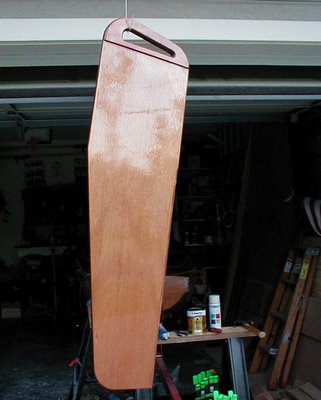
But a part of my Easter Sunday was spent in the holiday tradition of boat sanding. The rub rails, daggerboard, rudder head, rudder blade, and mast step all got a good sanding before being coated with a second coat of epoxy. After all that, I even had some time and energy left for some more sanding of the hull interior. Even after an initial going-over with 120-grit paper, there are some rough, orange-peel like sections in the hull interior where the epoxy application wasnt the greatest. Still more work to be done there.

So tonight, I gave that second coat of epoxy on the daggerboard another sanding. I hit it with the 120, then a pass with 220-grit. It looked good enough that curiosity finally overtook me, and I popped the top on a can of Interlux Schooner Varnish. My reading had prepared me for how touchy the application of varnish might be. So I had a small roller for application, and a foam brush standing by for "tipping in", or removing bubbles left by the roller. I was surprised how easily the varnish went on the daggerboard (after I had carefully wiped it free of sanding dust). It didnt even seem necessary to tip in very much. I was careful to apply a thin coat, and all looked good as the daggerboard lay flat. But as soon as I lifted it to do the other side, sags appeared. With subsequent coats, Ill have to be even more careful to put down thinner coats. But overall, I was pleased. It is said one must do a good job sanding, because varnish wont hide any flaws. But I was pleased to find some of the very small sanding swirls and lines did get covered up. Finally, I knew bugs would be a problem with the fresh varnish surface, so I was careful to not turn on my powerful worklights in the open garage as twilight set. But even with no lights, bugs were attracted, and a couple are now stuck in the finish. Ill have to do further coats at a time other than twilight, and most likely with the garage door closed. Fortunately, the garage has a couple of screened windows I can open for ventilation. All in all, a good experiment; one I should be able to improve upon. Total hours 79.25.

Read more

Senin, 11 April 2016

Music Whenever The Speakeasies Swing Band Theme from Godfather

0

The Star Wars movie series is fun - at least the recent one matches the first three in touching all the buttons - but, lets be honest, still sci-fi fluff. But the Godfather, the Dark Side not as a caricature, but the Dark Side we can relate too, the one that is embedded into our brain as the true dichotomy, the statement of the paradox of the human animal.

A great cover of the Godfather theme, the wistful, tender, but ultimately boppy love song (lyrics by Larry Kusik, and music by Nino Rota) underpinning a movie about the battle of the black souls, call them anti-heroes, but seared into our culture nonetheless..


Read more

Seen at the 2015 Annapolis Sailboat Show The Portland Pudgy dinghy

0

I spent an interesting fifteen minutes over at the Portland Pudgy stand. The Portland Pudgy is a another variation on the dinghy tender; this one in rotomolded plastic, with an emphasis on dual use as a life-boat if disaster struck. After looking the Portland Pudgy over, one comes away with the impression of a different take on the cruising dinghy; well designed, not too expensive, commodious despite the short length, and buoyant enough to work out as a life boat if needed.

All of my time spent at the stand was in talking with Pam, the wife of the designer, David Hulbert. We mostly discussed the travails of running a Mom and Pop boat production business, particularly how little things can gum production up. The sub-contractor that made the specialty designed inspection ports for the Portland Pudgy went bankrupt, unbeknownst to the Pudgy production team. When they went over to subcontractors shop, they found it shuttered up with the specialty tooling for the inspection ports locked inside. Once they got it all sorted with a new subcontractor there was a three month hiatus on getting Pudgys out the door. I detected an undertone in her story of maybe this was too much, too all consuming, particularly for a couple in their senior years. But the Portland Pudgy does offer something unique in the boating world and there appears to be a steady market going forward.

The FAQ page on the Portland Pudgy as a straight up dinghy.

The FAQ page on the Portland Pudgy sailing rig.


Read more

Sabtu, 09 April 2016

Geezer Racing The Gentlemans Way

0

The formula:
  1. Get a small two-man dinghy with, and this is important, NO SPINNAKER!
  2. Make sure the wind is light so NO HIKING! (Well, maybe some leaning out is OK.)
  3. Assign one geezer as PORT helmsman and the other as STARBOARD helmsman which eliminates any one person actually crossing the entire boat on tacks
  4. Enjoy whatever the competition brings!


Read more

Jumat, 08 April 2016

Header Photo Bermuda Fitted Dinghy in the Drink

0


The previous header photo was of a Bermuda Fitted Dinghy on her side. This is the second time I have put the Bermuda Fitted Dinghy up as a header photo. Even though I consider the Bermuda Fitted Dinghy the most photogenic of all dinghy classes, it is obvious that this photo doesnt do justice to the sweet sheer, rounded lines and huge rig of the Fitted Dinghy. But the possibility of capsize is always lurking for the inattentive or for those who sail extremely over-canvassed dinghies, as is the case here. Just part of the fun and this blog takes a perverse delight (since the blogmeister has certainly spent his fair share swimming alongside a dinghy) in featuring photos of capsizes.

Here is a quadcopter video by Andrew Stevenson of the Bermuda Fitted Dinghies racing. (Light winds so no drama.) I cant embed it but you can follow this link to view the video.

Read more

 
Powered by Blogger