Hull panel offsets for the Mistral can be found here.
In the ongoing coverage of John Zs Classic Moth build, last week I stopped over at his shop to gauge his progress and have a beer. The Classic Moth modified Mistral design is now upside down awaiting gunwhales and a layer of 4 oz. glass over the bottom.
This photo, though perhaps a tad distorted, shows how deeply Veed the Mistral design sections are around the midships.

Transom view with a pretty swirly pattern from the okoume plywood.

John, with the about-to-be-opened bottle of stout peeking up above the keel-line of his Moth.

A man and his workbench. John graciously took down a Marblehead RC sailboat he built many years ago so I could take a closer look.

A man and his workbench - take 2.

From the previous photo, you can see that John has some interesting stuff hanging from his walls. This is the box containing his F1 rubber-band indoor airplanes. These are extremely finicky to make, with a minimum weight of one gram. John has all the various tools to test balsa density and strength; tools to strip balsa into extremely narrow widths; tools to check rubber band elasticity; molds to make the tricky propellers, and the various techniques to apply the ultra-thin microfilm covering. To make a F1 takes a methodical, painstaking craftsman.

John also has two half models of the Americas Cup, IACC keelboats, the class that precedes the current foiling catamarans. Surprisingly, it was through his wifes connections and not his Naval Architect circle of friends that these two half-models now grace his shop.


In the ongoing coverage of John Zs Classic Moth build, last week I stopped over at his shop to gauge his progress and have a beer. The Classic Moth modified Mistral design is now upside down awaiting gunwhales and a layer of 4 oz. glass over the bottom.
This photo, though perhaps a tad distorted, shows how deeply Veed the Mistral design sections are around the midships.
Transom view with a pretty swirly pattern from the okoume plywood.
John, with the about-to-be-opened bottle of stout peeking up above the keel-line of his Moth.
A man and his workbench. John graciously took down a Marblehead RC sailboat he built many years ago so I could take a closer look.
A man and his workbench - take 2.
From the previous photo, you can see that John has some interesting stuff hanging from his walls. This is the box containing his F1 rubber-band indoor airplanes. These are extremely finicky to make, with a minimum weight of one gram. John has all the various tools to test balsa density and strength; tools to strip balsa into extremely narrow widths; tools to check rubber band elasticity; molds to make the tricky propellers, and the various techniques to apply the ultra-thin microfilm covering. To make a F1 takes a methodical, painstaking craftsman.
John also has two half models of the Americas Cup, IACC keelboats, the class that precedes the current foiling catamarans. Surprisingly, it was through his wifes connections and not his Naval Architect circle of friends that these two half-models now grace his shop.




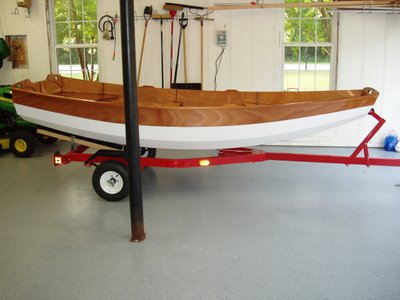
 In the calm, cool morning air, my Passagemaker Dinghy got her long-awaited first coat of varnish. For the bright finish, I am using Interlux Schooner varnish. This product will give a high gloss, while also giving UV protection to the underlying epoxy. On the whole, I was pleased with how the first attempt went. I was able to experiment with the application characteristics of the varnish on the daggerboard, which got a first coat some time ago. There certainly is a lot of surface area on the inside of this boat! I used a roller to cover some of the larger, flat expanses. But a foam brush was still needed for tipping in, and also for the many tight spots and corners. Keeping the coat as thin as possible, I think I managed to avoid many drips and sags. The entire interior and exterior transoms and sheer strake took just about one-half quart to coat. I have three quarts on hand, which will give me enough for the recommended 5-6 coats that are needed for a durable finish. Even after this first, I am encouraged with how things look. And now, Im more eager than ever to get out on the water! Total Hours 90.50.